Yule: Hope & Gratitude, Darkness & Monsters
- Dec 19, 2025
- 12 min read
The longest night approaches. Another sacred turning of the wheel. Darkness softens. Light stirs beneath the surface. The Earth whispers a soft promise of renewal.
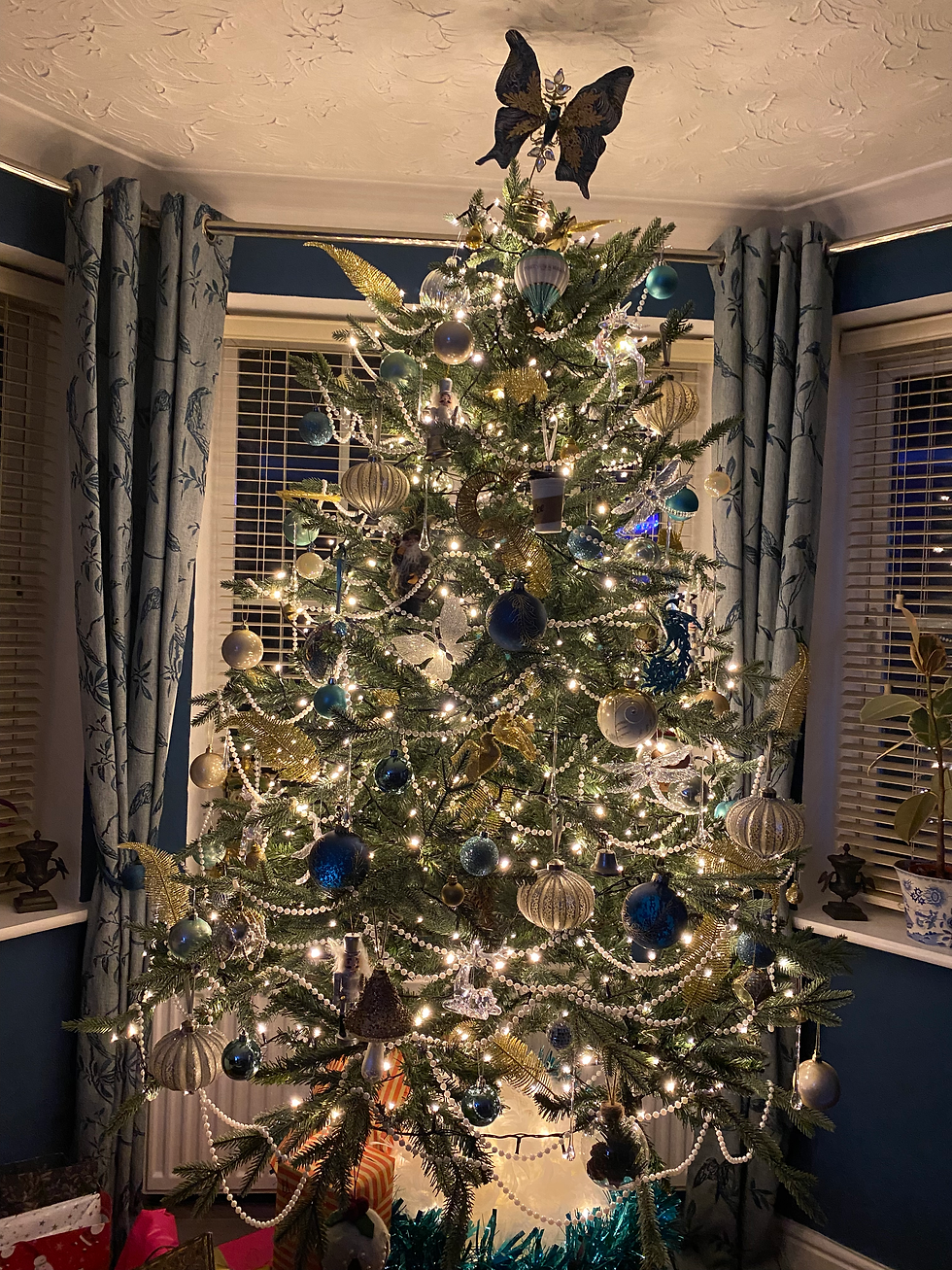
People tend to look at me like I’m weird when I say I have 8 Yule trees in my house… at least one in every room. But I love this season. It’s dark outside, and cosy and twinkly indoors. It’s an invitation to stay in and rest up. It’s a moment to enjoy the simple pleasures of home and hearth. It’s a pause in the chaos of life and a time of family and connection.
All my family love our Yuletide House and I spend hours at the start of every December dressing my home and lighting every corner with the soft twinkling of fairy lights and glitter. When there are so few hours of sun, every light becomes sacred.
This is a time of hope and gratitude, the candles and lights reflecting the light of our inner flame, ever burning, no matter the season. Creating warmth and safety in the home reminds us to cultivate that same warmth and safety within our hearts.
Yule - a festival that's hard to define.
The Winter Solstice. The Sun is reborn. Can you get quiet and listen closely? Feel the awakening? A long way off from spring but stirring… stirring. Releasing what’s too heavy to carry through into the new season. Reclaiming the sacred.
It’s really difficult to talk about “Yule” as a standalone event in the turning of the wheel. It seems like, during the darkest part of the year, our human power of imagination through time and global culture has turned all the way up to maximum. Folklore tales, myth and legend, from all over the northern hemisphere, all has some part to play in our collective experience of the Winter Solstice and Yule is just one small part of the story.
So I’ll take you on a whistlestop tour through the longest night but there’s so much more… this is definitely a compelling rabbit hole to peer into. Indeed, many of these folk stories would bear an entire blog post to themselves.
But for now let’s go into the dark. To learn about Krampus, the Yule Cat, The Wild Hunt and the Deer Mother. The Old Yule. This season is hushed, ancient and full of monsters…
Cats, Trolls and Scary Monsters
The people of Iceland are truly connected to their folklore and their land spirits, of which I learned a little bit when I travelled there a couple of years ago. And they have some great winter tales which have developed over time.
Jólakötturinn, or The Yule Cat, is a favourite of mine. He’s a HUGE cat who stalks the night, looking for folks who have not received an item of new woollen clothing before Yule and eating them. In times gone by, he would only eat the meals of those who had not received clothing (the threat of being without food during the winter was more than enough), but he definitely took on a scarier aspect as the years went by and the concerns about starvation became less pressing.

Jólakötturinn belongs to a family of trolls under the matriarchy of Grýla. Trolls are a big deal in Iceland and not to be messed with. Grýla and her 13 children, The Yule Boys, are no exception. She sends out one of her children every night in the 13 days before Yule and if they find an open door, they will go in and cause mischief and mayhem in your house. Grýla is also thought to scoop up any errant children whom she finds out and about in the cold and put them in her sack to take home and feed her family. EEEK! Sometimes, Icelandic children will leave a shoe out for the Yule Lads and can expect to find it filled with sweets and treats if they’ve been good – but if not, they’ll be the recipient of a rotten old potato instead.
Far from being scary stories, these serve as symbolic cautionary tales to make sure you stay in, keep doors and windows closed, wrap up warm and keep your food stores safe during those cold Icelandic winters!

In a similar vein, we have the terrifying Krampus, a monstrous being from Alpine folklore who stalks the land after dark, the shadowy counterpart to the beloved St Nicholas. He’s hooved, horned and furred and carries bundles of birch sticks, chains and sacks. Whilst St. Nick rewards good children, Krampus deals with the badly behaved… an important balancing act of cosmic justice.
Krampusnacht, December 5th, sees parades, costumes and revelries to chase away evil and darkness. Krampus represents the shadow side of the season: accountability, boundaries and the facing of fears instead of avoiding them.
Much like Jólakötturinn and Grýla, Krampus is a protector archetype who carries out his cosmic duty using a tough love approach, helping the cutting of cords with bad habits and the release of draining patterns of behaviour.

In Scandinavia, the Julbock (Yule Goat) is a symbol connecting to the grain harvest. He was once a scary goat who roamed around on Christmas night, demanding food. In later times, his reputation improved and he even became associated with the delivery of gifts, often being ridden by elves as they conducted their Christmas business of gift-giving. The elves eventually got replaced by Santa but even he could occasionally be seen with a goat in tow. Santa Claus himself, St Nicholas or Father Christmas, is said to have evolved from the idea of the Norse god Óðinn (Odin), Alföðr (the Allfather).
Sometimes, children will leave a shoe full of barley for Julbock, who is also associated with the Norse god Þórr (Thor) and the harvest spirits.

Io Saturnalia!
The Spirit of the Harvest is further preserved in the ancient Roman festival of mayhem and revelry, SATURNALIA (17-23 Dec). This was a feast to honour Saturn, god of agriculture, and marked the end of the planting season. All folk in the household (including slaves) would throw a dice to appoint the “Saturnalicus Princeps” or Lord of Misrule and everyone else became equals; slave and master alike. This was a feast of joy, fertility and abundance and the giving of small token gifts was an integral part of this event.

After Saturnalia, the birth of Mithras or “Sol Invictus” (The Unconquerable Sun) was celebrated on December 25, which the Ancient Romans marked as the solstice.
Know of any other light-bringing special sons who were born on this date?
More Land Spirits
Two of the most significant characters in the Pagan understanding of land and spirit are the Holly King and the Oak King, mortal enemies who battle for supremacy in an never-ending cycle. There are various schools of thought around these two and when they gain and reach the height of their power. One such theory maintains that, on the winter solstice, the Holly King relinquishes his crown to the Oak King but this is not my belief. I believe that the Holly King reaches the height of his power on the longest night and only weakens enough to be defeated by the Oak King on the Spring Equinox.
Some folks further believe that these power transfers take place on the cross quarters (Samhain and Beltane) and in all fairness, I can get with that theory but it’s up to you to decide what you believe and maybe it depends on where you live and how the seasons affect your locality.
Some believe that the Gaulish horned god Cernunnos is the entire divine masculine and embodies both the Holly and the Oak Kings in dual aspects of himself. This also works for me!

But let’s move over into a more feminine influence on the season. Frau Holle is a Norse entity appearing in many Scandinavian myths and legends. She associated with evergreen plants and the snowfall, which is said to be created by her shaking out her feathery mattresses.
Let's also consider for a moment the wonderful Deer Mother. She appears in folk tradition all across the Northern Hemisphere as a divine bringer of light. She is said to travel between the worlds of the living and the dead and brings the light back to the long darkness in between her horns at the time of the Winter Solstice. The Deer Mother is a symbol of power, hope, guidance strength and resilience and is linked closely to Shamanic journeying.
And if you weren’t already aware, female deer do not shed their antlers in winter like males so when you see the reindeer pulling Santa’s sleigh, that’s a group of beautiful does showing off some seasonal girl power.

Pubs and Pwnco
A rather bizarre tradition arising in Wales is that of the Mari Lwyd. I couldn’t really find any reason for why it happens so maybe if you’re a local to that area reading this, you could enlighten me. It’s a fun wassailing tradition whereby the skull of a horse is mounted on a pole, shrouded with a veil and paraded around the town accompanied by a procession of characters including jesters and fine ladies, echoing the medieval “mumming” performance traditions. The Mari Lwyd will knock on the door of both private and public houses, engaging the occupants in a series of jovial poetic exchanges. The poems (Pwnco) are often silly or lewd and eventually, the occupants are expected to give in and let the whole troupe in, including the horse, which will chase everyone around, snapping its bony jaw at them in a mischievous ritual of merriment and fun believed to bring joy and good fortune to the places it visits. And why not!

Symbols of Yule (or some of them!)
Most of us proudly display the symbols of the Yule in our homes at this time of year, whether knowingly or not. So let’s go through a few of the traditional “Christmas” decorations and rituals and link them back to where they came from: this very Pagan and ancient festival of Yule.
Trees – bringing an evergreen tree into the home and adorning it with myriad lights symbolises the preservation of the light during the dark months as well as representing the eternal and everlasting nature of the earth and protecting this at all costs. There is also a charming Ukrainian story of the Christmas Spider which tells of a poverty-stricken mother bringing in her tree but cannot afford the decorations and adornments like the other families in the village so the children go to bed disappointed. During the night, a compassionate spider decorates the tree with her webs that glint and glisten when the light catches them, thus delighting the children and amazing the whole village.
Spiders are a symbol of help, protection and wisdom in the home so it’s deeply appropriate to place a spider decoration on your tree so you can remember how even the smallest of creatures can exert a great influence on the quality of our lives.

Wreaths – these symbolise the wheel of the year, the cycle of life. Using evergreen materials: holly, ivy, mistletoe and berries echoes the sentiments of the section above.
Garlands – similar to wreaths but possibly slightly macabre as they also represent the Norse practice in antiquity of the hanging of animal entrails on certain trees as offerings to nature spirits to elicit protection. Later on these became prettified and made of flowers and evergreens, symbolising joy and abundance.

Mistletoe – this is an evergreen that grows even in dormant trees. It is seen worldwide as a symbol of fertility and hope, even in the dead of winter. Ancient Romans hung it in doorways to encourage peace and goodwill and the Norse peoples held it sacred to love and peace. The Celts saw it as a universal healer with properties of fertility and love and a powerful holder of life force. The ancient Greeks saw it as an aid in journeys to the underworld and often hung it in liminal spaces such as doorways to facilitate this journeying. Kissing under the mistletoe came much later but it’s not hard to see where the tradition came from.

Yule Log – a small log of wood, often Oak, is adorned with candles and decorations, maybe carved with runes and sigils, perhaps anointed with honey or wine, as a temporary altar for Yule.
We burn the log to release the past year, to take advantage of the transformative properties of fire and to welcome the returning sun. Additionally, you can keep a part of the log, or even its ashes, to represent continuity, to protect your home and to carry the Yule blessings forward.
You can also buy or make a chocolate one and enjoy it as part of your Yule feasting!

But how does any of this affect us?
All this tradition and folklore is all very well and good but how does it carry into our personal practice in this day and age?
The Winter Descent, “seasonal affective disorder” (SAD Syndrome) is simply the body’s natural response to the season. It’s not a disorder at all. Less daylight means reduced serotonin and increased melatonin, producing changes to your circadian rhythms (body’s sleep patterns).
Our ancestors leaned into this but we try to cheat it with chemicals and schedules that demand the same levels of productivity as summer.
But what if we listened to ourselves instead?
What if, as the outer world gets quieter, we allow our inner worlds to get louder?
Yule = more introspection… more emotional sensitivity… increased imagination… better internal focus… deeper folklore traditions.
It’s not gloom! It’s the brain’s chance to return to baseline after months of overstimulation. It’s an opportunity for neurological reset.
Your own personal or family traditions and festivities are very important. The gathering of family and friends; the celebration of life and the gratitude for our wonderful lives is a truly integral part of the energy of the Yule season. It’s worth remembering that, even though we now have a culture of “rush rush rush” to get everything perfect for the holidays, that’s not what it’s all about. Not really.
And being a Pagan doesn't mean you can't enjoy the wonderful celebrations of a such an important Christian festival as Christmas, the birth of Jesus - because all these traditions intertwine so closely, it's hard to tell where one ends and the next begins. So you might as well lean into the festivities and have a great time however you want to!

Gathering to tell stories, share news and open up about our inner selves creates connection, keeps communities strong and awake during the long winter nights. Helping each other through difficulties, sharing resources (modern interpretation = giving gifts), eating meals together – all super-important. Touch is a grounding magic. Interpersonal connection is essential to remind us that we belong in a time when it would be easy to isolate and hibernate.
Introspection and Contemplation
As well as gathering and feasting, there is also opportunity for getting quiet. Yule is a season of resting, mending, reflection, conservation of energy and listening inwards.
Patience, stillness, trust that what is sleeping in you is just waiting to wake up again in spring.
A Yule Prayer “May this Yule bring peace to your spirit, protection to your path and a spark of new life to everything you are dreaming into existence”
Personal rituals might become slower and more contemplative.
Some ideas...
· The creating of a “simmer pot” of cinnamon, pine sprigs, dried orange peel and cloves in a pot of water and set to simmer, allowing the aroma to fill your home.
· Mindful clearing, cleaning and cleansing of your space using traditional methods of mop and cloth as well as smoke saining or intention with windows open (for a short time because remember: The Yule Lads!!!) to allow heavy energy to leave.
· Seeing Solstice as a quiet threshold. Before bed, write down what you hope the returning sun will bring. In the morning, note down any dream or image that appeared during sleep. These are guideposts from your intuition for the year ahead.
· Decorate your altar with evergreens and seasonal plants and use green, white and red candles to represent the everlasting Earth Mother, the passion of the returning sun and the purity of spirit. Here you can spend time in meditation and prayer, journaling and reflection.

Seasonal Plants
· Apples for love, healing and immortality
· Bay for protection, psychic power, healing, strength and purification
· Holly for protection, luck and dream magic
· Ivy for protection and healing
· Cranberry for protection
· Cinnamon for success and prosperity, healing and power, psychic power, love and lust
· Ginger for power, love, money and success
· Cedar for cleansing
· Pine for cleansing and endurance
Some Deities for the Winter Solstice
· Óðinn (Odin) - Norse god: Alföðr (the Allfather)
· Cernunnos - Celtic horned god
· Hekate - Ancient Greek chthonic goddess
· Cailleach - Celtic crone goddess
· Bona Dea - Ancient Roman fertility goddess
· Frau Holle - Norse crone goddess
· Dionysus - Ancient Greek god of wine and revelry
· Holly King and Oak King - Celtic seasonal gods and age-old adversaries
· Mithras - Ancient Roman god: The Unconquerable Sun - sometimes associated as an early understanding of... · Jesus - the Christian son of God
· Saturn - Ancient Roman god of Agriculture
· The Spider Woman - Hopi
· Mother Mary - Christian mother of Jesus Christ
There are lots more deities associated with this season, from all over the world... do you know any more?
Tending the Flame
Any spiritual practice is, and should be, completely unique and personal to you. As I always say: only do things you feel comfortable doing - do your research before trying any magical workings and make sure to behave appropriately when trekking and foraging. Stay safe and be responsible with the land and spirits.

Above all, use the Yule season to tend to your flame. Not for resolutions about new and unattainable things but the guarding of the embers which are worth tending.
How do you celebrate Yule? I love to hear all about your traditions and practices.
With much love,
Cheryl

SOURCES/Further Reading
· Hedgewitch: A Guide to Solitary Witchcraft by Rae Beth - Hale, 1996 - ISBN 0-7090-4851-3
· @hearthandherbwitch instagram
· @mdmatx instagram
· @the_chaotic_crone instagram
· @thealchemistpapers instagram
· @starlightandsage_ instagram
· @lidapavlova_magic instagram


The content is clear and well articulated on all the main points. I found the way the main points are highlighted useful. I found it useful to compare this text with other resources I had read. It is rare to find content so well structured on this topic.